
Case Study: How Precise Zone 2 Training Improved My Aerobic Ceiling on Only 5 Hrs/Week”
- gritlabsg
- May 12
- 3 min read

Updated: May 21
Problem
I wanted to improve my endurance fitness on only 5 hours of cycling per week — without relying on another painful FTP test or guessing my Zone 2 intensity.
I had previously done Zwift FTP tests and 20-minute all-out efforts, but I found them needlessly painful and would constantly postpone the tests. At the time due to work and family commitments, I was only training 5 hours per week, purely in Zone 2 and really wanted to maintain or even improve my performance on limited training time.
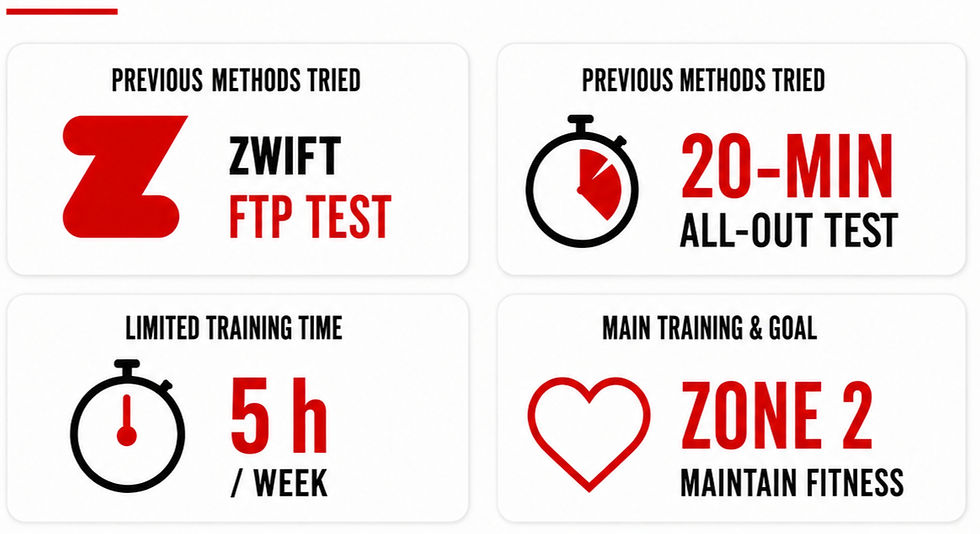
Especially for me, Zone 2 was not just training. It was also a way to de-stress and maintain fitness.
The goal was simple: Get precise intensity zones, maximise my training time - without needing to suffer through another maximal test.
I was pacing mostly by power, using RPE and heart rate as secondary checks.
Diagnosis
Using the GritLab Zone Clarity Framework, I compared my LT1, LT2, lactate curve, RPE, and training history to answer one key question:
Was I training close enough to my true Zone 2 ceiling to get the most out of only 5 hours per week?
Previous lactate testing 8 weeks ago showed that, I already had a strong Zone 2 power, also known as Lactate Threshold 1 (LT1) - relative to my FTP, also known as Lactate Threshold 2 (LT2)
That made sense. Most of my training was purely Zone 2-focused, with very little work above that range.
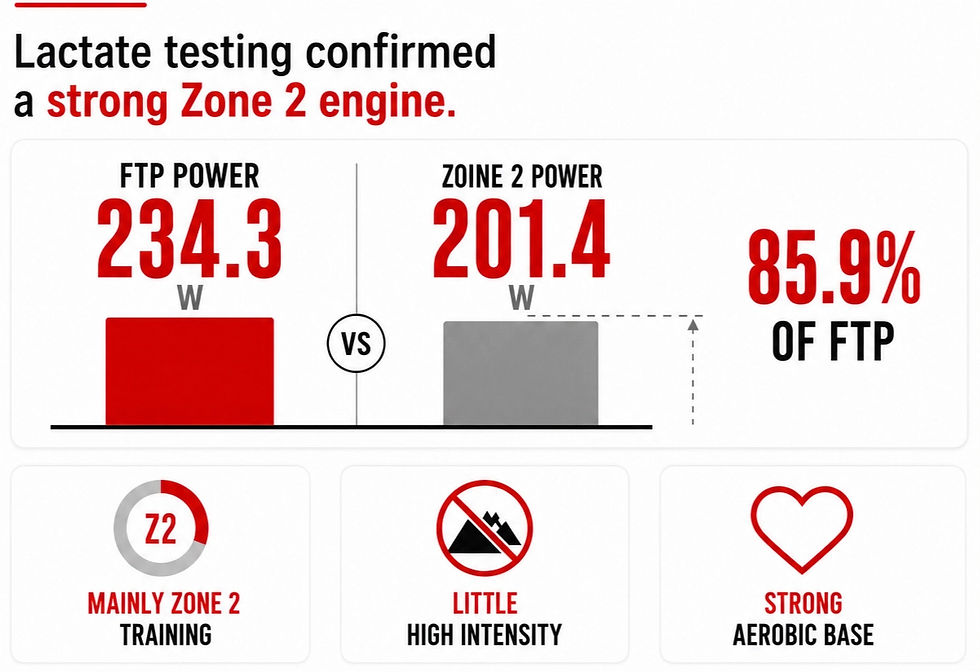


So the issue was not whether I could suffer harder.
The real issue was whether my Zone 2 intensity was precise enough to maximise limited training time without drifting too easy or too hard.
Solution
Using lactate testing, I determined my updated training zones without needing a maximal all-out effort.
Because I only had around 5 hours per week to train, I was to perform my Zone 2 rides closer to the tested Zone 2 ceiling, 201.4w, rather than riding too conservatively. I ultimately rode at 80% of my Zone 2 ceiling
To improve performance without adding more cycling volume, I also added:
Heavy lower-body strength training - which has shown to improve cycling performance
2 sessions per week
Which led to my squat strength increasing from 80kg -> 120kg for 10 reps.

Another hornourable mentions are Short sprint intervals - these intervals only last 10–30 seconds rep for a total of 4–6 sets and shown to improve time-trial performance from 212w -> 234w in active male in just 4 weeks!
Result
After just 8 weeks of consistent 5 hours of cycling & an addition of 2 heavy gym sessions per week.

FTP stayed essentially stable, while Zone 2 power improved from 201.4 W to 210 W.
More importantly, lactate values across all power intensities were lower than before, suggesting a stronger, more developed base and greater aerobic efficiency.


Key Takeaway

Important nuance: this was not just Zone 2 training in isolation. I also added 2 heavy lower-body strength sessions per week, which may have contributed to the improvement.
At the same time, I do not dismiss the value of more accurate training zones. From my personal observation, having clearer zones helped me train with better intent, avoid guessing, and track progress more objectively over time.
So the result is best interpreted as the combined effect of more precise Zone 2 training, better progress tracking, and strength training — not any single factor alone.
Reference
Gibala, M. J., Little, J. P., van Essen, M., Wilkin, G. P., Burgomaster, K. A., Safdar, A., Raha, S., & Tarnopolsky, M. A. (2006). Short-term sprint interval versus traditional endurance training: Similar initial adaptations in human skeletal muscle and exercise performance. The Journal of Physiology, 575(3), 901–911. https://doi.org/10.1113/jphysiol.2006.112094
Vikmoen, O., & Rønnestad, B. R. (2021). A comparison of the effect of strength training on cycling performance between men and women. Journal of Functional Morphology and Kinesiology, 6(1), Article 29. https://doi.org/10.3390/jfmk6010029


Comments