
Case Study (Diagnostic): Triathlete Went From Cramping After 40mins Despite 1200mg Sodium to a Gym-First Endurance Plan
- gritlabsg
- May 21
- 3 min read


Problem
The athlete was dealing with repeated race cramps, especially in hot conditions.
The cramps could appear during the swim, during the run, and sometimes as calf cramps around 35–40 minutes into racing.
Naturally, hydration and electrolytes were the first things to question.
He had already tried a fairly structured race-day nutrition setup:
A drink mix with 90g carbohydrates in an 850ml bottle per hour
And 1,200mg sodium during racing.

But despite taking electrolytes, the cramps were still happening.
That made the key question more specific: Was this really a sodium problem — or was something else?
Diagnostic
His sweat test revealed,
Sweat sodium concentration of 970mg per litre of sweat
Sweat fluid loss of 1.2 liter per hour, 1.7% of his bodyweight
Making the total sodium loss 1,164mg per hour.


Thus, his current electrolyte strategy of 1,200mg sodium matches his hourly sodium loss, indicating that sodium wasn't the clear issue. Therefore, while hydration could still be enhanced, the data implied that merely increasing electrolytes would probably not resolve the cramps.
The test also showed that:
His aerobic threshold, LT1, was 136W / 120 bpm.
His anaerobic threshold, LT2, was 183W / 147 bpm.

But the lactate values were highly elevated on the day, and the athlete confirmed he was in a fatigued state due to work and travel.
That mattered because the cramps were not happening in isolation. They were happening alongside fatigue, low training volume, limited long rides, previous weight loss, likely muscle loss, and no strength training.
He was only training around 4–5 hours per week across swim, bike, and run, and rarely cycled beyond 90 minutes.

So the diagnosis shifted.
This was probably not a sodium problem.
The more likely missing piece was muscular durability.
Solution
The first change was to stop treating the cramps as a pure hydration problem and shift toward building durability from multiple angles.

For endurance training, steady rides were kept closer to Zone 2 around 140W, instead of drifting too often into 160–170W tempo. This would help build aerobic fitness without constantly adding unnecessary fatigue.
Structured training was also recommended so his fitness could progress more predictably over time.
But the biggest recommendation was strength training.
Given his previous weight loss, likely muscle loss, lack of strength training, and cramping under race fatigue, this was the highest bang-for-buck change across all three sports.
The goal was simple:
Build stronger legs so each pedal stroke costs less effort.
Less relative effort means less fatigue.
Less fatigue means better durability under race conditions.
Progress would be judged by strength gains, because better strength can improve muscular durability, Zone 2 power, FTP, and time-trial performance.
He was advised to work with a competent personal trainer, ideally someone who understands performance, not just weight loss.
Nutrition was adjusted to support this. Protein intake was recommended at around 1.4–1.6g/kg/day, given his training demands and the goal of rebuilding strength.
Fluid intake was also increased, starting around 850ml–1.0L/hour, then refined based on ride duration, heat, and sweat rate.
For longer or hotter rides, the target was to replace around 80% of sodium loss, instead of blindly taking more electrolytes.
Key Takeaway
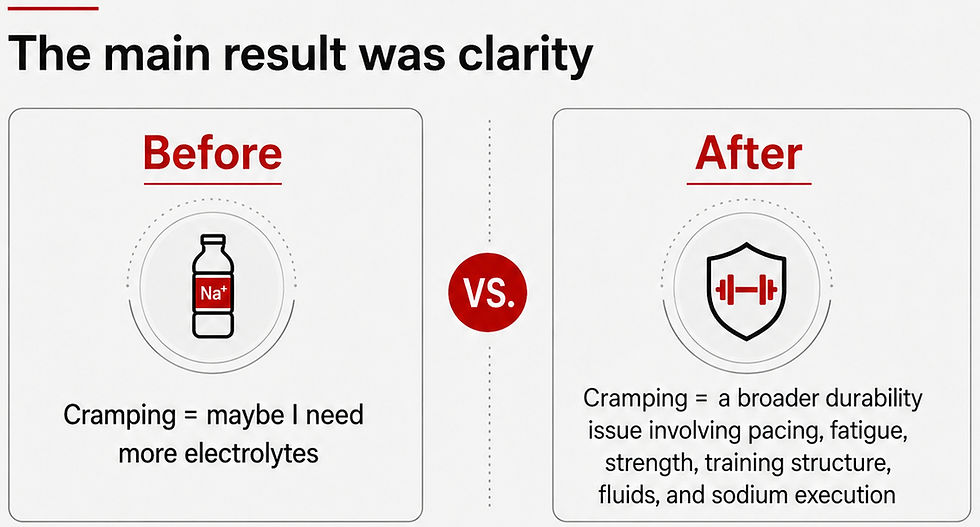
This is why pinpointing your bottleneck is crucial; focusing your efforts on the wrong area leads to poor results.
This athlete solution wasn't simply "more sodium." - it involved a comprehensive durability plan
If that seems like something you're experiencing as well, then click here.


Comments