
Case Study: How a Triathlete Went From Cramping at 1h:30m Despite Electrolytes to 3h:30m Cramp-Free
- gritlabsg
- May 11
- 3 min read

Problem
A triathlete preparing for the Desaru Half-Ironman kept cramping in both legs after around 1 hour 30 minutes in Singapore’s hot and humid conditions.
The confusing part? This did not look like a simple fitness issue,
Heart rate felt controlled
Legs felt strong before the cramps
Carb intake was already high: 90–100g/hour
Training volume was pretty solid: 9–10 hours/week
He had already tried various electrolyte products, including:

but taking electrolytes is not the same as taking enough electrolytes for your actual sweat loss. That was the key question we needed to test.
Diagnosis
Heat-Cramp Diagnostic Framework - We looked at four things: fueling, fluid loss, sodium loss, and whether his actual intake matched what he was losing in the heat.
Sweat testing showed that he was losing a very high amount of both fluid and sodium, even in relatively cooler test conditions.
Key results:

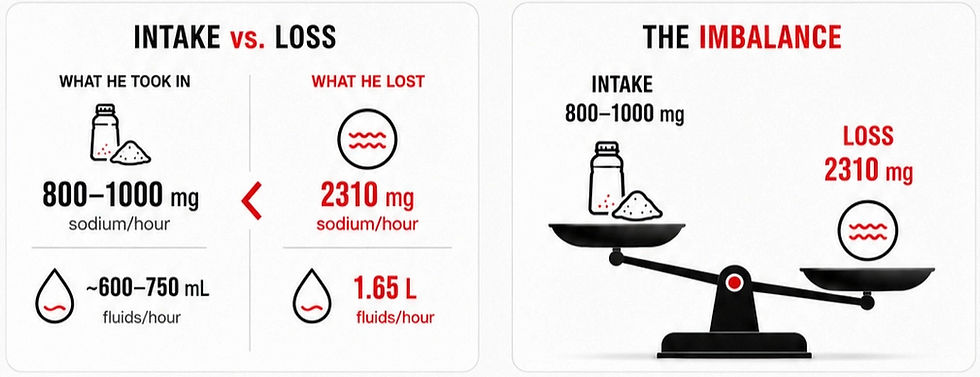
His measured losses were: 1.65L of fluid/hour and ~2310mg of sodium/hour. That means his previous hydration strategy was far below what his body actually needed.
Solution
The solution was to adjust his fluid and sodium intake based on his measured sweat profile.

Focus areas:
Increase fluid intake toward >1.5 L/hour, to reduce dehydration
Increase sodium intake toward ~2000 mg/hour, closer to measured sodium loss
then test it progressively in long rides to see whether cramps occurred later, earlier, or not at all.
Outcome / Early Field Result
After adjusting his hydration strategy, S.P rode during lunch hour in hotter afternoon conditions (~33°C)
Key results:

He reported that the cramps only occurred after 2h 30min, compared to 1h 30min previously.


That was a 60-minute delay in cramp onset — roughly 67% longer before cramping.
During that ride, he consumed:
💧 Fluid intake: 0.8 L/hour (up from 0.5L)
🧂 Sodium intake: 1600 mg/hour (up from 1000mg)
He was still below his measured sodium loss of ~2310mg/hour, so this was not a complete fix yet.
But the direction was clear: increasing fluid and sodium intake helped him last longer before cramping, even in hotter conditions.
2nd Field Result
Athlete rode again, this time during the morning in cooler conditions (~28°C)
Key results:
He reported no cramps after riding for 3h 30min, compared to 1h 30min originally.


During that ride, he consumed:
💧 Fluid intake: 1.2 L/hour (up from 0.5L)
🧂 Sodium intake: 2750 mg/hour (up from 1000mg)
His sodium intake now is a bit high, although he reported no stomach issues or performance issues. So now it's just fine-tuning so see what works well for even longer durations
Yet another clear direction: With increasing fluid and sodium intake, his cramping starts to get delayed.
Key Takeaway

This athlete was not simply unfit, undertrained, or bad at hydration.
The issue was that his fluid and sodium intake did not match what he was actually losing in the heat. That is why generic hydration advice often fails: two athletes can drink the same amount, take the same electrolytes, and still have very different outcomes.
Still cramping despite taking electrolytes?
If you cramp, fade, or struggle in hot races, this may apply to you too.
A Complete Heat & Performance Diagnostic helps turn your sweat and sodium losses into a clearer race-day hydration plan. Click on the 'I'm Ready For Clarity' button to get yours!
Important Note: Evidence directly linking sodium intake to cramp prevention is mixed - however, many athletes report fewer cramps and better performance when higher sodium intake helps them drink more fluid, maintain hydration, and tolerate longer efforts better. I treat sodium as one part of a broader hydration strategy — not a standalone cramp cure.


Comments